-

Comments on Greek painting, art, contemporary thought

Our blog is an artistic, cultural guide to the Greek landscapes. At the same time it offers an introduction to the history of Greek fine arts, Greek artists, mainly Greek painters, as well as to the recent artistic movements

Our aim is to present the Greek landscapes in a holistic way: Greek landscapes refer to pictures and images of Greece, to paintings and art, to poetry and literature, to ancient philosophy and history, to contemporary thought and culture...
--
--
greek artists, contemporary thought, greek painters, literature, greek paintings, modern greek artists


Showing posts with label still life. Show all posts

Monday, November 5, 2012

50 New Bookmarks from Yannis Stavrou' s paintings...


Just edited! 50 New Bookmarks from Yannis Stavrou' s paintings at the POLITEIA bookshops, 1 Asklipiou St, Athens, Greece...

Social & Economic Crisis - Time for Reading

Monday, December 13, 2010

Comments & Greek artists, Greek painters: little that is "good" about human beings...

Aphorisms & Greek artists, contemporary Greek painters


Yannis Stavrou, Still Life, oil on canvas

Still life is better...

On Humans...

I have found little that is "good" about human beings on the whole. In my experience most of them are trash, no matter whether they publicly subscribe to this or that ethical doctrine or to none at all. That is something that you cannot say aloud, or perhaps even think.


It is impossible to overlook the extent to which civilization is built upon a renunciation of instinct.


Sigmund Freud


Wednesday, September 29, 2010

Comments & Greek artists, Greek painters: leave the balcony open...

Poetry & Greek artists, contemporary Greek artists


Yannis Stavrou, Still Life, oil on canvas

Federico García Lorca

Farewell

If I die,

The little boy is eating oranges.
(From my balcony I can see him.)

The reaper is harvesting the wheat.
(From my balcony I can hear him.)

If I die,
leave the balcony open!

Little Viennese Waltz

In Vienna there are ten little girls,
a shoulder for death to cry on,
and a forest of dried pigeons.
There is a fragment of tomorrow
in the museum of winter frost.
There is a thousand-windowed dance hall.

Ay, ay, ay, ay!
Take this close-mouthed waltz.

Little waltz, little waltz, little waltz,
of itself of death, and of brandy
that dips its tail in the sea.

I love you, I love you, I love you,
with the armchair and the book of death,
down the melancholy hallway,
in the iris's darkened garret,

Ay, ay, ay, ay!
Take this broken-waisted waltz.

In Vienna there are four mirrors
in which your mouth and the ehcoes play.
There is a death for piano
that paints little boys blue.
There are beggars on the roof.
There are fresh garlands of tears.

Ay, ay, ay, ay!
Take this waltz that dies in my arms.

Because I love you, I love you, my love,
in the attic where the children play,
dreaming ancient lights of Hungary
through the noise, the balmy afternoon,
seeing sheep and irises of snow
through the dark silence of your forehead

Ay, ay, ay, ay!
Take this " I will always love you" waltz

In Vienna I will dance with you
in a costume with
a river's head.
See how the hyacinths line my banks!
I will leave my mouth between your legs,
my soul in a photographs and lilies,
and in the dark wake of your footsteps,
my love, my love, I will have to leave
violin and grave, the waltzing ribbons

Wednesday, September 22, 2010

Comments & Greek artists, painters: The spirits of the air live in the smells of fruit; and Joy...

Poetry & Greek painting, Greek artists, modern Greek artists


Yannis Stavrou, Autumn Synthesis, oil on canvas

O Autumn, laden with fruit, and stain'd
With the blood of the grape, pass not, but sit
Beneath my shady roof; there thou may'st rest...

William Blake

To Autumn

O Autumn, laden with fruit, and stain'd
With the blood of the grape, pass not, but sit
Beneath my shady roof; there thou may'st rest,
And tune thy jolly voice to my fresh pipe,
And all the daughters of the year shall dance!
Sing now the lusty song of fruits and flowers.

'The narrow bud opens her beauties to
The sun, and love runs in her thrilling veins;
Blossoms hang round the brows of Morning, and
Flourish down the bright cheek of modest Eve,
Till clust'ring Summer breaks forth into singing,
And feather'd clouds strew flowers round her head.

'The spirits of the air live in the smells
Of fruit; and Joy, with pinions light, roves round
The gardens, or sits singing in the trees.'
Thus sang the jolly Autumn as he sat,
Then rose, girded himself, and o'er the bleak
Hills fled from our sight; but left his golden load

Friday, September 10, 2010

Comments & Greek artists, modern Greek artists: And where the sunshine and shade of the earth ?

Poets & Greek artists, modern Greek painters, Greek painting


Yannis Stavrou, Seascape 2, oil on canvas

And where the sunshine
And shade of the earth ?
Walls stand cold
And speechless, in the wind
The wheathervanes creak...

Friedrich Hölderlin


In Lovely Blue

Like the stamen inside a flower
The steeple stands in lovely blue
And the day unfolds around its needle;
The flock of swallows that circles the steeple
Flies there each day through the same blue air
That carries their cries from me to you;
We know how high the sun is now
As long as the roof of the steeple glows,
The roof that’s covered with sheets of tin;
Up there in the wind, where the wind is not
Turning the vane of the weathercock,
The weathercock silently crows in the wind.


Half of Life

With its yellow pears
And wild roses everywhere
The shore hangs into the lake,
O gracious swans,
And drunk with kisses
You dip your heads
In the sobering holy water.
Ah, where will I find
Flowers, come winter,
And where the sunshine
And shade of the earth ?
Walls stand cold
And speechless, in the wind
The wheathervanes creak.

Wednesday, September 8, 2010

Comments & Greek artists, modern Greek artists: Rationalism is not enough in our times...

Short stories & Greek artists, modern Greek painters


Yannis Stavrou, Pomegranates (detail), oil on canvas

Pomegranates* for good luck...

Rationalism is not enough in our times...

We need other weapons to explain the huge barbarism around us...

Maybe, we should follow quantic paths...

Or science fiction...

Arthur Clark

Some Quotes


The greatest tragedy in mankind's entire history may be the hijacking of morality by religion.

The intelligent minority of this world will mark 1 January 2001 as the real beginning of the 21st century and the Third Millennium.

The limits of the possible can only be defined by going beyond them into the impossible.

The only way to discover the limits of the possible is to go beyond them into the impossible.

There is hopeful symbolism in the fact that flags do not wave in a vacuum.

This is the first age that's ever paid much attention to the future, which is a little ironic since we may not have one.

We have to abandon the idea that schooling is something restricted to youth. How can it be, in a world where half the things a man knows at 20 are no longer true at 40 - and half the things he knows at 40 hadn't been discovered when he was 20?

When a distinguished but elderly scientist states that something is possible, he is almost certainly right. When he states that something is impossible, he is very probably wrong.

I don't pretend we have all the answers. But the questions are certainly worth thinking about.

I have a fantasy where Ted Turner is elected President but refuses because he doesn't want to give up power.

If an elderly but distinguished scientist says that something is possible, he is almost certainly right; but if he says that it is impossible, he is very probably wrong.

It has yet to be proven that intelligence has any survival value.

It is not easy to see how the more extreme forms of nationalism can long survive when men have seen the Earth in its true perspective as a single small globe against the stars.

It may be that our role on this planet is not to worship God - but to create him.

New ideas pass through three periods: 1) It can't be done. 2) It probably can be done, but it's not worth doing. 3) I knew it was a good idea all along!

Our lifetime may be the last that will be lived out in a technological society.

Perhaps, as some wit remarked, the best proof that there is Intelligent Life in Outer Space is the fact it hasn't come here. Well, it can't hide forever - one day we will overhear it.

Politicians should read science fiction, not westerns and detective stories.

Reading computer manuals without the hardware is as frustrating as reading manuals without the software.

Sometimes I think we're alone in the universe, and sometimes I think we're not. In either case the idea is quite staggering.

-----------------

* The Pomegranate is a symbol of Good Luck in Greece

Monday, July 19, 2010

Comments & Greek artists, modern Greek artists: listen to the footsteps of time...

Autumn & Greek artists, modern Greek artists, Greek painters


Yannis Stavrou, Autumn Fruits, oil on canvas

in another time that is now,
listen to the footsteps of time,
inventor of places with no weight, nowhere,
listen to the rain running over the terrace...

Octavio Paz


As One Listens to the Rain

Listen to me as one listens to the rain,
not attentive, not distracted,
light footsteps, thin drizzle,
water that is air, air that is time,
the day is still leaving,
the night has yet to arrive,
figurations of mist
at the turn of the corner,
figurations of time
at the bend in this pause,
listen to me as one listens to the rain,
without listening, hear what I say
with eyes open inward, asleep
with all five senses awake,
it's raining, light footsteps, a murmur of syllables,
air and water, words with no weight:
what we are and are,
the days and years, this moment,
weightless time and heavy sorrow,
listen to me as one listens to the rain,
wet asphalt is shining,
steam rises and walks away,
night unfolds and looks at me,
you are you and your body of steam,
you and your face of night,
you and your hair, unhurried lightning,
you cross the street and enter my forehead,
footsteps of water across my eyes,
listen to me as one listens to the rain,
the asphalt's shining, you cross the street,
it is the mist, wandering in the night,
it is the night, asleep in your bed,
it is the surge of waves in your breath,
your fingers of water dampen my forehead,
your fingers of flame burn my eyes,
your fingers of air open eyelids of time,
a spring of visions and resurrections,
listen to me as one listens to the rain,
the years go by, the moments return,
do you hear the footsteps in the next room?
not here, not there: you hear them
in another time that is now,
listen to the footsteps of time,
inventor of places with no weight, nowhere,
listen to the rain running over the terrace,
the night is now more night in the grove,
lightning has nestled among the leaves,
a restless garden adrift-go in,
your shadow covers this page.

Wednesday, June 30, 2010

Comments & Greek paintings, Greek artists: Cutting the lemon the knife leaves a little cathedral...

Poets & Greek painters, Greek artists, Greek painting


Yannis Stavrou, Still Life, oil on canvas

so the freshness lives on
in a lemon,
in the sweet-smelling house of the rind,
the proportions, arcane and acerb...

Pablo Neruda
A Lemon

Out of lemon flowers
loosed
on the moonlight, love's
lashed and insatiable
essences,
sodden with fragrance,
the lemon tree's yellow
emerges,
the lemons
move down
from the tree's planetarium

Delicate merchandise!
The harbors are big with it-
bazaars
for the light and the
barbarous gold.
We open
the halves
of a miracle,
and a clotting of acids
brims
into the starry
divisions:
creation's
original juices,
irreducible, changeless,
alive:
so the freshness lives on
in a lemon,
in the sweet-smelling house of the rind,
the proportions, arcane and acerb.

Cutting the lemon
the knife
leaves a little cathedral:
alcoves unguessed by the eye
that open acidulous glass
to the light; topazes
riding the droplets,
altars,
aromatic facades.

So, while the hand
holds the cut of the lemon,
half a world
on a trencher,
the gold of the universe
wells
to your touch:
a cup yellow
with miracles,
a breast and a nipple
perfuming the earth;
a flashing made fruitage,
the diminutive fire of a planet.

Sunday, June 13, 2010

Comments & Greek artists: a civilization has the same fragility as a life...

Thoughts & Greek artists, modern Greek painters


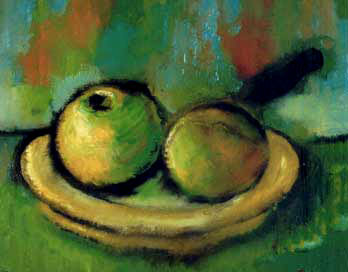
Yannis Stavrou, Still Life with Apples, oil on canvas

...And we see now that the abyss of history is deep enough to hold us all. We are aware that a civilization has the same fragility as a life...

Paul Valery
The Crisis of the Mind
1st Letter

We later civilizations . . . we too know that we are mortal.

We had long heard tell of whole worlds that had vanished, of empires sunk without a trace, gone down with all their men and all their machines into the unexplorable depths of the centuries, with their gods and their laws, their academies and their sciences pure and applied, their grammars and their dictionaries, their Classics, their Romantics, and their Symbolists, their critics and the critics of their critics. . . . We were aware that the visible earth is made of ashes, and that ashes signify something. Through the obscure depths of history we could make out the phantoms of great ships laden with riches and intellect; we could not count them. But the disasters that had sent them down were, after all, none of our affair.

Elam, Ninevah, Babylon were but beautiful vague names, and the total ruin of those worlds had as little significance for us as their very existence. But France, England, Russia...these too would be beautiful names. Lusitania too, is a beautiful name. And we see now that the abyss of history is deep enough to hold us all. We are aware that a civilization has the same fragility as a life. The circumstances that could send the works of Keats and Baudelaire to join the works of Menander are no longer inconceivable; they are in the newspapers. That is not all. The searing lesson is more complete still. It was not enough for our generation to learn from its own experience how the most beautiful things and the most ancient, the most formidable and the best ordered, can perish by accident; in the realm of thought, feeling, and common sense, we witnessed extraordinary phenomena: paradox suddenly become fact, and obvious fact brutally believed.

I shall cite but one example: the great virtues of the German peoples have begotten more evils, than idleness ever bred vices. With our own eyes, we have seen conscientious labor, the most solid learning, the most serious discipline and application adapted to appalling ends.
valery6667

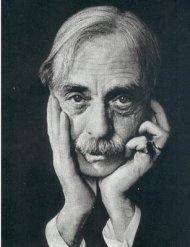
Paul Valéry (1871-1945)

So many horrors could not have been possible without so many virtues. Doubtless, much science was needed to kill so many, to waste so much property, annihilate so many cities in so short a time; but moral qualities in like number were also needed. Are Knowledge and Duty, then, suspect?

So the Persepolis of the spirit is no less ravaged than the Susa of material fact. Everything has not been lost, but everything has sensed that it might perish.

An extraordinary shudder ran through the marrow of Europe. She felt in every nucleus of her mind that she was no longer the same, that she was no longer herself, that she was about to lose consciousness, a consciousness acquired through centuries of bearable calamities, by thousands of men of the first rank, from innumerable geographical, ethnic, and historical coincidences.

So -- as though in desperate defense of her own physiological being and resources -- all her memory confusedly returned. Her great men and her great books came back pell-mell. Never has so much been read, nor with such passion, as during the war: ask the booksellers. . . . Never have people prayed so much and so deeply: ask the priests. All the saviors, founders, protectors, martyrs, heroes, all the fathers of their country, the sacred heroines, the national poets were invoked. . . .

And in the same disorder of mind, at the summons of the same anguish, all cultivated Europe underwent the rapid revival of her innumerable ways of thought: dogmas, philosophies, heterogeneous ideals; the three hundred ways of explaining the World, the thousand and one versions of Christianity, the two dozen kinds of positivism; the whole spectrum of intellectual light spread out its incompatible colors, illuminating with a strange and contradictory glow the death agony of the European soul. While inventors were feverishly searching their imaginations and the annals of former wars for the means of doing away with barbed wire, of outwitting submarines or paralyzing the flight of airplanes, her soul was intoning at the same time all the incantations it ever knew, and giving serious consideration to the most bizarre prophecies; she sought refuge, guidance, consolation throughout the whole register of her memories, past acts, and ancestral attitudes. Such are the known effects of anxiety, the disordered behavior of mind fleeing from reality to nightmare and from nightmare back to reality, terrified, like a rat caught in a trap. . . .

The military crisis may be over. The economic crisis is still with us in all its force. But the intellectual crisis, being more subtle and, by it nature, assuming the most deceptive appearances (since it takes place in the very realm of dissimulation)...this crisis will hardly allow us to grasp its true extent, its phase.

No one can say what will be dead or alive tomorrow, in literature, philosophy, aesthetics; no one yet knows what ideas and modes of expression will be inscribed on the casualty list, what novelties will be proclaimed.

Hope, of course, remains -- singing in an undertone:

Et cum vorandi vicerit libidinem
Late triumphet imperator spiritus.

But hope is only man's mistrust of the clear foresight of his mind. Hope suggests that any conclusion unfavorable to us must be an error of the mind. And yet the facts are clear and pitiless; thousands of young writers and artists have died; the illusion of a European culture has been lost, and knowledge has been proved impotent to save anything whatsoever; science is mortally wounded in its moral ambitions and, as it were, put to shame by the cruelty of its applications; idealism is barely surviving, deeply stricken, and called to account for its dreams; realism is hopeless, beaten, routed by its own crimes and errors; greed and abstinence are equally flouted; faiths are confused in their aim -- cross against cross, crescent against crescent; and even the skeptics, confounded by the sudden, violent, and moving events that play with our minds as a cat with a mouse . . . even the skeptics lose their doubts, recover, and lose them again, no longer master of the motions of their thought.

The swaying of the ship has been so violent that the best-hung lamps have finally overturned. . . .

What gives this critical condition of the mind its depth and gravity is the patient's condition when she was overcome.

I have neither the time nor the ability to define the intellectual situation in Europe in 1914. And who could pretend to picture that situation? The subject is immense, requiring every order of knowledge and endless information. Besides, when such a complex whole is in question, the difficulty of reconstructing the past, even the recent past, is altogether comparable to that of constructing the future, even the near future; or rather, they are the same difficulty. The prophet is in the same boat as the historian. Let us leave them there.

For all I need is a vague general recollection of what was being thought just before the war, the kinds of intellectual pursuit then in progress, the works being published.

So if I disregard all detail and confine myself to a quick impression, to that natural whole given by a moment's perception, I see . . . nothing! Nothing . . . and yet an infinitely potential nothing.

The physicists tell us that if the eye could survive in an oven fired to the point of incandescence, it would see . . . nothing. There would be no unequal intensities of light left to mark off points in space. That formidable contained energy would produce invisibility, indistinct equality. Now, equality of that kind is nothing else than a perfect state of disorder.

And what made that disorder in the mid of Europe? The free coexistence, in all her cultivated minds, of the most dissimilar ideas, the most contradictory principles of life and learning. That is characteristic of a modern epoch.

I am not averse to generalizing the notion of "modern" to designate certain ways of life, rather than making it purely a synonym of contemporary. There are moments and places in history to which we moderns could return without greatly disturbing the harmony of those times, without seeming objects infinitely curious and conspicuous . . . creatures shocking, dissonant, and unassimilable. Wherever our entrance would create the least possible sensation, that is where we should feel almost at home. It is clear that Rome in the time of Trajan, or Alexandria under the Ptolemies, would take us in more easily than many places less remote in time but more specialized in a single race, a single culture, and a single system of life.

Well then! Europe in 1914 had perhaps reached the limit of modernism in this sense. Every mind of any scope was a crossroads for all shades of opinion; every thinker was an international exposition of thought. There were the works of the mind in which the wealth of contrasts and contradictory tendencies was like the insane displays of light in the capitals of those days: eyes were fatigued, scorched.... How much material wealth, how much labor and planning it took, how many centuries were ransacked, how many heterogeneous lives were combined, to make possible such a carnival, and to set it up as the supreme wisdom and the triumph of humanity?

In a book of that era -- and not one of the most mediocre -- we should have no trouble in finding: the influence of the Russian ballet, a touch of Pascal's gloom, numerous impressions of the Goncourt type, something of Nietzsche, something of Rimbaud, certain effects due to a familiarity with painters, and sometimes the tone of a scientific publication...the whole flavored with an indefinably British quality difficult to assess! Let us notice, by the way, that within each of the components of this mixture other bodies could well be found. It would be useless to point them out: it would be merely to repeat what I have just said about modernism, and to give the whole history of the European mind.

Standing, now, on an immense sort of terrace of Elsinore that stretches from Basel to Cologne, bordered by the sands of Nieuport, the marshes of the Somme, the limestone of Champagne, the granites of Alsace . . . our Hamlet of Europe is watching millions of ghosts.

But he is an intellectual Hamlet, meditating on the life and death of truths; for ghosts, he has all the subjects of our controversies; for remorse, all the titles of our fame. He is bowed under the weight of all the discoveries and varieties of knowledge, incapable of resuming the endless activity; he broods on the tedium of rehearsing the past and the folly of always trying to innovate. He staggers between two abysses -- for two dangers never cease threatening the world: order and disorder.

Every skull he picks up is an illustrious skull. This one was Leonardo. He invented the flying man, but the flying man has not exactly served his inventor's purposes. We know that, mounted on his great swan (il grande uccello sopra del dosso del suo magnio cecero) he has other tasks in our day than fetching snow from the mountain peaks during the hot season to scatter it on the streets of towns. And that other skull was Leibnitz, who dreamed of universal peace. And this one was Kant...and Kant begat Hegel, and Hegel begat Marx, and Marx begat. . . .

Hamlet hardly knows what to make of so many skulls. But suppose he forgets them! Will he still be himself? His terribly lucid mind contemplates the passage from war to peace: darker, more dangerous than the passage from peace to war; all peoples are troubled by it. . . . "What about Me," he says, "what is to become of Me, the European intellect? ...And what is peace? Peace is perhaps that state of things in which the natural hostility between men is manifested in creation, rather than destruction as in war. Peace is a time of creative rivalry and the battle of production; but I am not tired of producing? Have I not exhausted my desire for radical experiment, indulged too much in cunning compounds? ...Should I not perhaps lay aside my hard duties and transcendent ambitions? Perhaps follow the trend and do like Polonius who is now director of a great newspaper; like Laertes, who is something in aviation; like Rosencrantz, who is doing God knows what under a Russian name?

"Farewell, ghosts! The world no longer needs you -- or me. By giving the names of progress to its own tendency to a fatal precision, the world is seeking to add to the benefits of life the advantages of death. A certain confusion still reigns; but in a little while all will be made clear, and we shall witness at last the miracle of an animal society, the perfect and ultimate anthill."

Friday, May 21, 2010

Comments & Greek painters, Greek artists: My gaze is clear like a sunflower...

Poetry & Greek painting, Greek artists, Greek painters


Yannis Stavrou, Still Life with Apples, oil on canvas

Fernando Pessoa
Quotes

No intelligent idea can gain general acceptance unless some stupidity is mixed in with it.


All is worthwhile if the soul is not small.


At first, it's unfamiliar, then it strikes root.

Could it think, the heart would stop beating.

Success consists in being successful, not in having potential for success. Any wide piece of ground is the potential site of a palace, but there's no palace till it's built.

To choose ways of not acting was ever the concern and scruple of my life.

To feel today what one felt yesterday isn't to feel - it's to remember today what was felt yesterday, to be today's living corpse of what yesterday was lived and lost.

Wise is he who enjoys the show offered by the world.

https://blogger.googleusercontent.com/img/b/R29vZ2xl/AVvXsEiUL2wpYC44bqR_DM-zlN1v62fQFZWO7vWi21E6NGVe9KWubUSR-NtAVFmxSW4V6KfIKU1U2NBSmKh_CBQoQzr-99NfY20NwifUJF78uLrcwlG6ER3E6psGWEMYyTHhKPQRd6HA4SrQ-kQQ/s320/fernando_pessoa.jpg
Fernando Pessoa (1885-1935)


The Keeper of Sheep II
(translated by Richard Zenith)

My gaze is clear like a sunflower.
It is my custom to walk the roads
Looking right and left
And sometimes looking behind me,
And what I see at each moment
Is what I never saw before,
And I’m very good at noticing things.
I’m capable of feeling the same wonder
A newborn child would feel
If he noticed that he’d really and truly been born.
I feel at each moment that I’ve just been born
Into a completely new world…

I believe in the world as in a daisy,
Because I see it. But I don’t think about it,
Because to think is to not understand.
The world wasn’t made for us to think about it
(To think is to have eyes that aren’t well)
But to look at it and to be in agreement.

I have no philosophy, I have senses…
If I speak of Nature it’s not because I know what it is
But because I love it, and for that very reason,
Because those who love never know what they love
Or why they love, or what love is.

To love is eternal innocence,
And the only innocence is not to think…

I don’t know if the stars rule the world
(translated by Richard Zenith)

I don’t know if the stars rule the world
Or if Tarot or playing cards
Can reveal anything.
I don’t know if the rolling of dice
Can lead to any conclusion.
But I also don’t know
If anything is attained
By living the way most people do.

Yes, I don’t know
If I should believe in this daily rising sun
Whose authenticity no one can guarantee me,
Or if it would be better (because better or more convenient)
To believe in some other sun,
One that shines even at night,
Some profound incandescence of things,
Surpassing my understanding.

For now...
(Let’s take it slow)
For now
I have an absolutely secure grip on the stair-rail,
I secure it with my hand –
This rail that doesn’t belong to me
And that I lean on as I ascend...
Yes... I ascend...
I ascend to this:
I don’t know if the stars rule the world.

Friday, May 14, 2010

Comments & Greek artists, modern Greek painters: We are never so ridiculous through what we are as through what we pretend to be...

Aphorisms & Greek painting, Greek painters, Greek artists


Yannis Stavrou, Still life, oil on canvas

On human nature...

Francois de La Rochefoucauld
Aphorisms

If we did not flatter ourselves, the flattery of others could never harm us.

If we had no faults of our own, we should not take so much pleasure in noticing those in others.

Innocence does not find near so much protection as guilt.

It is from a weakness and smallness of mind that men are opinionated; and we are very loath to believe what we are not able to comprehend.

It is often laziness and timidity that keep us within our duty while virtue gets all the credit.

Mediocre minds usually dismiss anything which reaches beyond their own understanding.

Nothing prevents one from appearing natural as the desire to appear natural.

People always complain about their memories, never about their minds.

Perfect behaviour is born of complete indifference.

Perfect Valour is to do, without a witness, all that we could do before the whole world.

Philosophy finds it an easy matter to vanquish past and future evils, but the present are commonly too hard for it.

Quarrels would not last long if the fault was only on one side.

The principal point of cleverness is to know how to value things just as they deserve.


Francois de La Rochfoucauld (1613-1680)

The reason why so few people are agreeable in conversation is that each is thinking more about what he intends to say than others are saying.

The surest way to be deceived is to consider oneself cleverer than others.

There are various sorts of curiosity; one is from interest, which makes us desire to know that which may be useful to us; and the other, from pride which comes from the wish to know what others are ignorant of.

There is nothing men are so generous of as advice.

Those who are incapable of committing great crimes do not readily suspect them in others.

Those who occupy their minds with small matters, generally become incapable of greatness.

Though men are apt to flatter and exalt themselves with their great achievements, yet these are, in truth, very often owing not so much to design as chance.

Usually we praise only to be praised.

Virtue would go far if vanity did not keep it company.

We always love those who admire us, but we do not always love those whom we admire.

We are more interested in making others believe we are happy than in trying to be happy ourselves.

We are never so ridiculous through what we are as through what we pretend to be.

We are so accustomed to disguise ourselves to others that in the end we become disguised to ourselves.

We easily forgive our friends those faults that do no affect us ourselves.

We have no patience with other people's vanity because it is offensive to our own.

We often forgive those who bore us, but we cannot forgive those whom we bore.

We often pardon those that annoy us, but we cannot pardon those we annoy.

We only confess our little faults to persuade people that we have no big ones.

We promise according to our hopes and perform according to our fears.

We promise in proportion to our hopes, and we deliver in proportion to our fears.
Υποσχόμαστε σε αναλογία με τις ελπίδες μας και διανέμουμε σε αναλογία με τους φόβους μας.

We should often feel ashamed of our best actions if the world could see all the motives which produced them.

Weakness of character is the only defect which cannot be amended.

What keeps us from abandoning ourselves entirely to one vice, often, is the fact that we have several.

What men have called friendship is only a social arrangement, a mutual adjustment of interests, an interchange of services given and received; it is, in sum, simply a business from which those involved propose to derive a steady profit for their own self-love.

What seems to be generosity is often no more than disguised ambition, which overlooks a small interest in order to secure a great one.

What we call generosity is for the most part only the vanity of giving; and we exercise it because we are more fond of that vanity than of the thing we give.

Thursday, April 22, 2010

Comments & Greek painting, Greek artists: Genius always gives its best at first; prudence, at last...

Aphorisms & modern Greek artists, Greek painters


Yannis Stavrou, Still Life, oil on canvas

For greed all nature is too little...


Lucius Annaeus Seneca
Aphorisms

Everything is the product of one universal creative effort. There is nothing dead in Nature. Everything is organic and living, and therefore the whole world appears to be a living organism.


Everywhere is nowhere. When a person spends all his time in foreign travel, he ends by having many acquaintances, but no friends.

Expecting is the greatest impediment to living. In anticipation of tomorrow, it loses today.

For greed all nature is too little.

For many men, the acquisition of wealth does not end their troubles, it only changes them.

Genius always gives its best at first; prudence, at last.

God is the universal substance in existing things. He comprises all things. He is the fountain of all being. In Him exists everything that is.

Great grief does not of itself put an end to itself.

He has committed the crime who profits by it.

He that does good to another does good also to himself.

He who does not prevent a crime when he can, encourages it.

He who dreads hostility too much is unfit to rule.

He who has great power should use it lightly.

He who is brave is free.

Health is the soul that animates all the enjoyments of life, which fade and are tasteless without it.

I don't consider myself bald, I'm just taller than my hair.

I don't trust liberals, I trust conservatives.

I never come back home with the same moral character I went out with; something or other becomes unsettled where I had achieved internal peace; some one or other of the things I had put to flight reappears on the scene.

I shall never be ashamed of citing a bad author if the line is good.

I will govern my life and thoughts as if the whole world were to see the one and read the other, for what does it signify to make anything a secret to my neighbor, when to God, who is the searcher of our hearts, all our privacies are open?

As is a tale, so is life: not how long it is, but how good it is, is what matters.


As long as you live, keep learning how to live.

Be wary of the man who urges an action in which he himself incurs no risk.

Behold a worthy sight, to which the God, turning his attention to his own work, may direct his gaze. Behold an equal thing, worthy of a God, a brave man matched in conflict with evil fortune.

Believe me, that was a happy age, before the days of architects, before the days of builders.

Brave men rejoice in adversity, just as brave soldiers triumph in war.

Call it Nature, Fate, Fortune; all these are names of the one and selfsame God.

Consider, when you are enraged at any one, what you would probably think if he should die during the dispute.

Constant exposure to dangers will breed contempt for them.

Consult your friend on all things, especially on those which respect yourself. His counsel may then be useful where your own self-love might impair your judgment.

Crime when it succeeds is called virtue.

Death is the wish of some, the relief of many, and the end of all.

Difficulties strengthen the mind, as labor does the body.

Do everything as in the eye of another.

Do not ask for what you will wish you had not got.

Even after a bad harvest there must be sowing.

Every guilty person is his own hangman.

Every man prefers belief to the exercise of judgment.

Every reign must submit to a greater reign.

Every sin is the result of a collaboration.

Saturday, March 6, 2010

Comments & contemporary Greek artists: Everything popular is wrong...

Aphorisms & Greek artists, modern Greek artists


Yannis Stavrou, Still Life - detail, oil on canvas

About humans, society, art...

Oscar Wilde
Aphorisms

A little sincerity is a dangerous thing, and a great deal of it is absolutely fatal.
A man can be happy with any woman as long as he does not love her.

Always forgive your enemies; nothing annoys them so much.
Democracy means simply the bludgeoning of the people by the people for the people.

Do you really think it is weakness that yields to temptation? I tell you that there are terrible temptations which it requires strength, strength and courage to yield to.

Education is an admirable thing, but it is well to remember from time to time that nothing that is worth knowing can be taught.

Every portrait that is painted with feeling is a portrait of the artist, not of the sitter.

Every saint has a past and every sinner has a future.

Everybody who is incapable of learning has taken to teaching.

Everything popular is wrong.

Experience is one thing you can't get for nothing.

Experience is simply the name we give our mistakes.

Fashion is a form of ugliness so intolerable that we have to alter it every six months.

Fathers should be neither seen nor heard. That is the only proper basis for family life.

Hatred is blind, as well as love.

He has no enemies, but is intensely disliked by his friends.

How can a woman be expected to be happy with a man who insists on treating her as if she were a perfectly normal human being.

How marriage ruins a man! It is as demoralizing as cigarettes, and far more expensive.

I always pass on good advice. It is the only thing to do with it. It is never of any use to oneself.

I am not young enough to know everything.

I am so clever that sometimes I don't understand a single word of what I am saying.

I am the only person in the world I should like to know thoroughly.

I can resist everything except temptation.

America had often been discovered before Columbus, but it had always been hushed up.
America is the only country that went from barbarism to decadence without civilization in between.

Anyone who lives within their means suffers from a lack of imagination.

Arguments are to be avoided; they are always vulgar and often convincing.

At twilight, nature is not without loveliness, though perhaps its chief use is to illustrate quotations from the poets.

Biography lends to death a new terror.

Consistency is the last refuge of the unimaginative.

Every portrait that is painted with feeling is a portrait of the artist, not of the sitter.

Fashion is a form of ugliness so intolerable that we have to alter it every six months.
Genius is born--not paid.

I always like to know everything about my new friends, and nothing about my old ones.

I am not young enough to know everything.

I think that God in creating Man somewhat overestimated his ability.

I was working on the proof of one of my poems all the morning, and took out a comma. In the afternoon I put it back again.

If you want to tell people the truth, make them laugh, otherwise they'll kill you.

Illusion is the first of all pleasures.

It is a very sad thing that nowadays there is so little useless information.

It is always a silly thing to give advice, but to give good advice is fatal.

Man is least himself when he talks in his own person. Give him a mask, and he will tell you the truth.

Morality, like art, means drawing a line someplace.

Most modern calendars mar the sweet simplicity of our lives by reminding us that each day that passes is the anniversary of some perfectly uninteresting event.

Most people are other people. Their thoughts are someone elses opinions, their lives a mimicry, their passions a quotation.

Music makes one feel so romantic - at least it always gets on one's nerves - which is the same thing nowadays.
One can survive everything, nowadays, except death, and live down everything except a good reputation.

One should always play fairly when one has the winning cards.

Patriotism is the virtue of the vicious.

Monday, February 15, 2010

Comments & Greek paintings, Greek artists: Every man bears the whole stamp of the human condition...

Aphorisms & Greek artists, Greek paintings, Greek painters


Yannis Stavrou, Still Life, oil on canvas

A great mind...

About human nature...

Michel de Montaigne
Aphorisms

  • A man who fears suffering is already suffering from what he fears.
  • A straight oar looks bent in the water. What matters is not merely that we see things but how we see them.
  • A wise man never loses anything, if he has himself.
  • A wise man sees as much as he ought, not as much as he can.
  • Age imprints more wrinkles in the mind than it does on the face.
  • Ambition is not a vice of little people.
  • An unattempted lady could not vaunt of her chastity.
  • An untempted woman cannot boast of her chastity.
  • Any person of honor chooses rather to lose his honor than to lose his conscience.
  • Confidence in others' honesty is no light testimony of one's own integrity.
  • Confidence in the goodness of another is good proof of one's own goodness.
  • Covetousness is both the beginning and the end of the devil's alphabet - the first vice in corrupt nature that moves, and the last which dies.
  • Death, they say, acquits us of all obligations.
  • Even from their infancy we frame them to the sports of love: their instruction, behavior, attire, grace, learning and all their words azimuth only at love, respects only affection. Their nurses and their keepers imprint no other thing in them.
  • Every man bears the whole stamp of the human condition.
  • Every one rushes elsewhere and into the future, because no one wants to face one's own inner self.
  • Fame and tranquility can never be bedfellows.
  • Few men have been admired of their familiars.
  • For truly it is to be noted, that children's plays are not sports, and should be deemed as their most serious actions.
  • Fortune, seeing that she could not make fools wise, has made them lucky.
  • He who establishes his argument by noise and command shows that his reason is weak.
  • He who fears he shall suffer, already suffers what he fears.
  • How many condemnations I have witnessed more criminal than the crime!
  • How many things we held yesterday as articles of faith which today we tell as fables.
  • I care not so much what I am to others as what I am to myself. I will be rich by myself, and not by borrowing.
  • I do myself a greater injury in lying than I do him of whom I tell a lie.
  • I do not speak the minds of others except to speak my own mind better.
  • I have never seen a greater monster or miracle in the world than myself.
  • I have often seen people uncivil by too much civility, and tiresome in their courtesy.
  • I know well what I am fleeing from but not what I am in search of.
  • I prefer the company of peasants because they have not been educated sufficiently to reason incorrectly.
  • I put forward formless and unresolved notions, as do those who publish doubtful questions to debate in the schools, not to establish the truth but to seek it.
  • I quote others only in order the better to express myself.
  • I set forth a humble and inglorious life; that does not matter. You can tie up all moral philosophy with a common and private life just as well as with a life of richer stuff. Each man bears the entire form of man's estate.
  • I speak the truth not so much as I would, but as much as I dare, and I dare a little more as I grow older.
  • I study myself more than any other subject. That is my metaphysics, that is my physics.
  • I write to keep from going mad from the contradictions I find among mankind - and to work some of those contradictions out for myself.
  • If a man should importune me to give a reason why I loved him, I find it could no otherwise be expressed, than by making answer: because it was he, because it was I.

Tuesday, February 2, 2010

Comments & Greek artists, Greek painters, Greek paintings: Travel Greece through Greek poets & Greek artists...

Greek culture & greek artists, greek painters, greek fine art


Yannis Stavrou, Still life with Green Apples, oil on canvas

An invitation to travel...

Travel Greece through culture...

Travel Greece through Greek poets...

The King of Asine
Iliad
Giorgos Seferis


All morning long we looked around the citadel
starting from the shaded side, there where the sea,
green and without luster—breast of a slain peacock—
received us like time without an opening in it.
Veins of rock dropped down from high above,
twisted vines, naked, many-branched, coming alive
at the water’s touch, while the eye following them
struggled to escape the tiresome rocking,
losing strength continually.

On the sunny side a long empty beach
and the light striking diamonds on the huge walls.
No living thing, the wild doves gone
and the king of Asine, whom we’ve been trying to find for
two years now,
unknown , forgotten by all, even by Homer,
only one word in the Iliad and that uncertain,
thrown here like the gold burial mask.
You touched it, remember its sound? Hollow in the light
like a dry jar in dug earth:
the same sound that our oars make in the sea.
The king of Asine a void under the mask
everywhere with us everywhere with us, under a name:
“Αsίνην te... Αsίνην te...”
and his children statues
and his desires the fluttering of birds, and the wind
in the gaps between his thoughts, and his ships
anchored in a vanished port:
under the mask a void.

Behind the large eyes the curved lips the curls
carved in relief on the gold cover of our existence
a dark spot that you see traveling like a fish
in the dawn calm of the sea:
a void everywhere with us.
And the bird that flew away last winter
with a broken wing:
abode of life,
and the young woman who left to play
with the dogteeth of summer
and the soul that sought the lower world squeaking
and the country like a large plane-leaf swept along by the
torrent of the sun
with the ancient monuments and the contemporary sorrow.

And the poet lingers, looking at the stones, and asks himself
does there really exist
among these ruined lines, edges, points, hollows, and curves
does there really exist
here where one meets the path of rain, wind, and ruin
does there exist the movement of the face, shape of the
tenderness
of those who’ve shrunk so strangely in our lives,
those who remained the shadow of waves and thoughts with
the sea’s boundlessness
or perhaps no, nothing is left but the weight
the nostalgia for the weight of a living existence
there where we now remain unsubstantial, bending
like the branches of a terrible willow-tree heaped in
permanent despair
while the yellow current slowly carries down rushes up-
rooted in the mud
image of a form that the sentence to everlasting bitterness
has turned to stone:
the poet a void.

Shieldbearer, the sun climbed warring,
and from the depths of the cave a startled bat
hit the light as an arrow hits a shield:
“Αsίνην te...Αsίνην te...” Would that it were the king
of Asine
we’ve been searching for so carefully on this acropolis
sometimes touching with our fingers his touch upon
the stones.

Asine, summer ´38—Athens. Jan. ´40